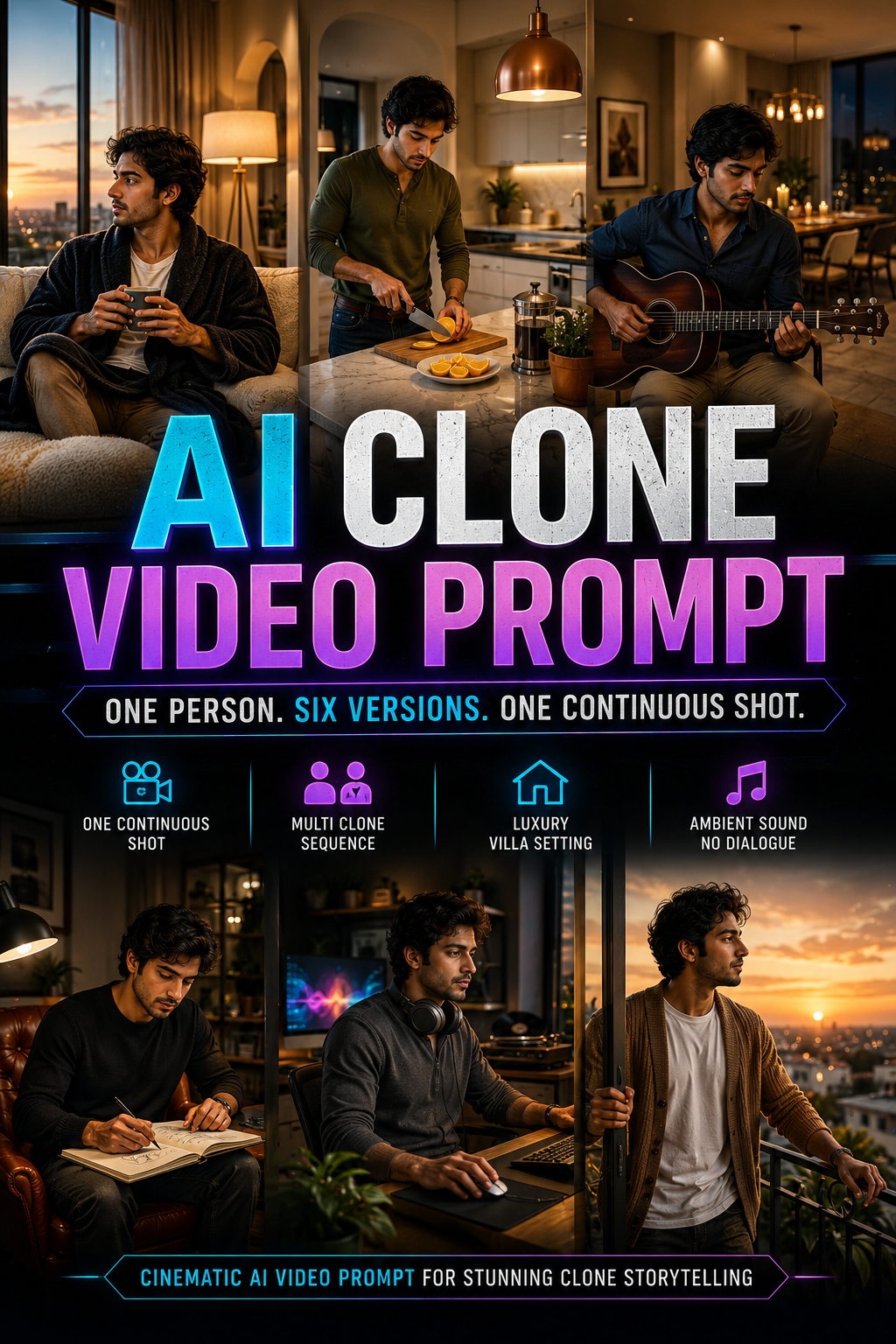
Create a Multi-Clone AI Video in One Continuous Shot
This AI video concept places multiple versions of the same person inside one large modern villa. Each version has a different outfit, room and activity. The camera moves continuously from left to right without cuts while the clones enter and leave the frame in a controlled rolling sequence.
The supplied concept uses two connected 10-second video prompts. Part 1 moves from the living room through the kitchen and dining room. Part 2 continues from the exact ending position of Part 1, then moves through the study, home studio and balcony terrace.
The identity of every clone comes from the reference image. The prompt uses different clothing and activities to distinguish each version while keeping the same face.
Part 1: Living Room to Dining Room
Part 1 is a 10-second vertical 9:16 cinematic video. It uses one uninterrupted camera movement through a spacious luxury villa. There is no dialogue, voiceover or direct interaction with the camera.
The Villa Environment
The setting is a spacious, high-ceiling modern villa with warm oak floors, cream plaster walls and tall floor-to-ceiling windows. Warm golden evening light enters through the windows. Open archways, wide corridors and large areas of open floor create physical separation between each clone.
The Camera Movement
The camera moves slowly from left to right in one continuous dolly-style pan. There are no cuts, jump cuts or shaky movements. The framing remains intimate rather than becoming a wide architectural establishing shot.
Each clone stays waist-up or chest-up and fills approximately one third to one half of the frame height. This keeps facial expressions, hand movements and clothing details visible.
The Rolling Clone Transition
The key visual rule is the rolling pair transition. A previous clone remains partially visible at the left edge while the next clone enters from the right. Once the new clone becomes fully visible, the previous clone exits.
The prompt strictly limits the scene to a maximum of two visible clones at any moment. This prevents three versions of the same person from appearing simultaneously.
Vertical 9:16, 10-second cinematic video, PART 1 OF 2, single continuous unbroken shot with a smooth slow camera pan moving through a luxurious, spacious modern villa, photorealistic. No dialogue, no voiceover, no speaking. Only ambient sounds and soft background music. The same person appears multiple times as different versions of himself. Each clone wears a different outfit and performs a different activity in a different room or zone of the villa. Only 1 to 2 clones are visible in the frame at any given moment. SUBJECT: All clones are the same person with an identical face. Each clone is dressed differently and absorbed in his own activity. No clone speaks. No clone looks at the camera. Silent, natural slice-of-life energy. The person's identity comes from the reference image, not from text description. HOME SETTING: A spacious, high-ceiling modern villa with an open flowing layout. Polished warm oak hardwood floors. Soft cream plaster walls. Tall floor-to-ceiling windows. Warm golden evening light. The home must feel genuinely large and expansive, not like a compact apartment. PART 1: Living room → open space → kitchen → corridor → dining room. CAMERA: Single smooth continuous dolly and pan shot moving gently from left to right. No cuts. No jump cuts. No shaky movement. No rapid movement. FRAMING: Every clone is framed waist-up or chest-up and fills approximately one-third to one-half of the frame height. Keep faces, hand movements and outfit details clearly visible. CLONE VISIBILITY: Use a rolling pair pattern. When a new clone appears, the previous clone remains partially visible at the left edge. Once the new clone fully enters, the previous clone exits. Never show three clones simultaneously. SEQUENCE: Seconds 0 to 2: LIVING ROOM, CLONE 1 ALONE. Clone 1 lounges on a deep cream bouclé sofa. He wears a plush dark charcoal bathrobe over a white tee. He holds a steaming ceramic mug with both hands and slowly sips while looking toward the floor-to-ceiling window. A warm floor lamp glows behind him. Mood: quiet and contemplative. Seconds 2 to 4: TRANSITION, CLONE 1 + CLONE 2. Clone 1 moves toward the left edge while remaining partially visible. The camera crosses an open archway and several meters of hardwood floor. Clone 2 enters from the right in the kitchen. Clone 2 wears a fitted olive-green henley and dark denim jeans. He stands at a white marble island slicing an orange on a wooden cutting board. Seconds 4 to 5.5: KITCHEN, CLONE 2 ALONE. Clone 1 fully exits. Clone 2 continues preparing food and arranges fruit slices on a plate. A French press and small herb plant are visible behind him. Seconds 5.5 to 7.5: TRANSITION, CLONE 2 + CLONE 3. Clone 2 moves toward the left edge. The camera crosses a warm hallway with wall sconces. Clone 3 enters from the right in the dining room. Clone 3 wears a relaxed navy-blue linen button-down shirt and khaki chinos. He holds an acoustic guitar and strums gently while looking at the fretboard. Warm candlelight illuminates his face. Seconds 7.5 to 10: DINING ROOM, CLONE 3 + CLONE 4. Clone 2 fully exits. Clone 3 moves toward the left edge. Clone 4 enters through a wide doorway from the right. Clone 4 wears a black crew-neck sweater and dark grey trousers. He sits in a camel-brown leather armchair with a sketchbook on his lap. He sketches with a pencil while maintaining a focused expression. The camera slows as Clone 4 becomes centered. End with Clone 3 at the far left edge and Clone 4 centered to establish the continuation into Part 2. LIGHTING: Warm golden-hour evening light with soft interior lighting from floor lamps, pendant lights, wall sconces and candles. Soft natural shadows. No harsh contrast. AUDIO: No dialogue. No voiceover. No speaking. Use gentle guitar strumming, quiet kitchen sounds and the soft clink of a mug under a calm lo-fi or ambient instrumental track. STYLE: Photorealistic. Premium cinematic quality. Shallow depth of field. Soft background bokeh. Natural skin textures. Realistic fabric folds. Subtle atmospheric haze. FORBIDDEN: No dialogue. No speaking. No voiceover. No clone looking at the camera. No cuts. No jump cuts. No more than two clones visible at any moment. No three-clone composition. No unrealistic proximity between clones. No cluttered interiors. No messy interiors. No dark or moody atmosphere. No text or letters in the scene. No selfie framing. No shaky camera. No rapid movement. No surreal effects. No exaggerated effects. COLOR: Warm cream, charcoal, soft white, warm oak and walnut. Outfit accents include olive green, navy and camel. Premium cinematic color grading with lifted shadows and soft filmic warmth.
Part 2: Study to Balcony Terrace
Part 2 continues directly from the final frame of Part 1. Clone 3 remains at the left edge while Clone 4 is centered. The camera continues the same left-to-right movement without restarting the visual sequence.
Continuity Is the Main Requirement
The opening state must match the ending state of Part 1. Clone 3 wears the navy linen shirt and holds the guitar. Clone 4 wears the black sweater and continues sketching in the camel leather armchair.
From there, Clone 3 exits, Clone 4 continues alone, and the camera introduces Clone 5 in a home studio. Clone 5 then exits as Clone 6 enters near the balcony. The video finishes with Clone 6 alone in the sunset.
Vertical 9:16, 10-second cinematic video, PART 2 OF 2, direct seamless continuation of Part 1. Single continuous unbroken shot with the same smooth slow camera pan continuing from left to right through the same luxurious, spacious modern villa. Photorealistic. No dialogue. No voiceover. No speaking. Only ambient sounds and soft background music. CONTINUITY: Part 2 begins exactly where Part 1 ended. Clone 3, wearing the navy linen shirt and holding the guitar, is at the left edge. Clone 4, wearing the black sweater and sketching in the camel leather armchair, is centered. The camera resumes the same forward glide. SUBJECT: The same person appears as every clone. All clones have identical faces because their identity comes from the reference image. Each clone wears a different outfit and performs a different activity. No clone speaks. No clone looks at the camera. HOME: Same spacious modern villa. Warm oak floors. Cream plaster walls. Tall windows. Warm golden evening light. PART 2: Study alcove → hallway → home studio → glass corridor → balcony terrace. CAMERA: Continue the same smooth continuous dolly and pan movement. No cuts. No jump cuts. No shaky movement. No rapid movement. FRAMING: Every clone remains waist-up or chest-up. Keep faces, expressions, hand movements and clothing clearly visible. CLONE VISIBILITY: Maximum two clones visible at any moment. Use the same rolling pair pattern. SEQUENCE: Seconds 0 to 2: STUDY ALCOVE. Clone 3 remains partially visible at the far left edge, then completely exits. Clone 4 is alone. He continues sketching in the camel leather armchair. His pencil moves in deliberate strokes. He occasionally pauses to examine the drawing. The warm desk lamp illuminates his face. Seconds 2 to 4: TRANSITION, CLONE 4 + CLONE 5. Clone 4 moves toward the left edge. The camera passes through a warm hallway with framed photographs, art prints and recessed spotlights. Clone 5 enters from the right through a wide doorway into a separate home studio. Clone 5 wears a dark grey quarter-zip pullover and black trousers. He sits at a walnut desk wearing over-ear headphones. One hand rests on a sleek mouse. A soft colorful monitor glow illuminates his face. A vinyl record player is visible on a low credenza behind him. Seconds 4 to 5.5: HOME STUDIO, CLONE 5 ALONE. Clone 4 fully exits. Clone 5 remains alone. He leans back slightly, removes the headphones and rests them around his neck. He then leans forward and types. The studio feels creative and personal. Seconds 5.5 to 7.5: TRANSITION, CLONE 5 + CLONE 6. Clone 5 moves toward the left edge. The camera passes through a glass-walled corridor opening toward the exterior. Golden evening light floods through the glass. Clone 6 enters from the right near a wide glass sliding door. Clone 6 wears a camel-brown knit cardigan over a plain white tee with dark navy joggers. He opens the glass door with one hand. Warm outdoor light falls across his face and chest. Seconds 7.5 to 10: BALCONY TERRACE, CLONE 6 ALONE. Clone 5 fully exits. Clone 6 stands alone on the balcony. He is framed chest-up from a slight angle. He leans on a simple black metal railing. Behind him is a softly blurred golden-hour cityscape with warm rooftops and a glowing sunset sky. A gentle breeze moves his hair and cardigan. The camera slowly comes to a stop. The final frame shows Clone 6 alone against the warm golden sky. The ending should feel peaceful and cinematic. LIGHTING: Continue the same warm golden-hour lighting from Part 1. Use warm recessed lights, desk lighting and wall sconces indoors. The balcony uses rich amber, soft peach and golden sunset tones. The transition from warm interior light to outdoor sunset should feel natural. AUDIO: No dialogue. No voiceover. No speaking. Use subtle mouse clicks, the sound of the glass door sliding and a gentle evening breeze. Continue the same calm lo-fi or ambient instrumental track from Part 1. STYLE: Photorealistic. Premium cinematic quality. Shallow depth of field. Soft bokeh. Natural skin textures. Realistic fabric and material rendering. The balcony finale has stronger golden backlight and a warm rim light around Clone 6. FORBIDDEN: No dialogue. No speaking. No voiceover. No clone looking at the camera. No cuts. No jump cuts. No more than two clones visible at any moment. No three-clone composition. No unrealistic proximity between clones. No cluttered interiors. No messy interiors. No dark or moody atmosphere. No text or letters in the scene. No selfie framing. No shaky camera. No rapid movement. No surreal effects. No exaggerated effects. No abrupt ending. COLOR: Continue the warm neutral palette from Part 1. Use cream, charcoal, warm oak and walnut. Outfit accents include dark grey, camel brown and navy. The terrace becomes warmer with amber-gold and soft peach sunset tones. Premium cinematic grading with lifted shadows, soft filmic warmth and a satisfying golden finale.
How the Six Clone Sequence Works
The concept uses six versions of the same person. Each version appears in a different part of the villa and performs a different activity.
- Clone 1 relaxes on the sofa with a mug.
- Clone 2 prepares fruit in the kitchen.
- Clone 3 plays an acoustic guitar in the dining room.
- Clone 4 sketches in the study alcove.
- Clone 5 works at a desk in the home studio.
- Clone 6 moves onto the balcony and watches the sunset.
The activities create a natural progression from quiet indoor moments toward the final outdoor scene. The camera provides the connection between each version of the person.
Why the Part 1 and Part 2 Continuity Matters
The two prompts are designed to work as a connected sequence. Part 2 does not introduce a new camera position or reset the environment. It begins from the final composition of Part 1.
The final frame of Part 1 must visually match the opening frame of Part 2. Clone positions, outfits, room location and camera direction all need to remain consistent.
Key Continuity Elements
- Same person and identical facial identity.
- Same villa architecture.
- Same warm golden-hour lighting.
- Same camera direction.
- Same slow camera movement.
- Same maximum of two visible clones.
- Clone 3 exits before the sequence introduces later clones.
- Clone 4 carries directly into the home studio transition.
Visual Style and Atmosphere
The source prompt uses a premium photorealistic cinematic style. It combines shallow depth of field, soft background bokeh, natural skin textures, realistic fabrics and subtle atmospheric haze.
The main palette stays warm and neutral. Cream, charcoal, soft white, warm oak and walnut establish the interior. Olive green, navy and camel provide controlled outfit variation.
The final balcony scene becomes warmer, using deeper amber, soft peach and golden tones as the sunset becomes the visual focus.
Practical Workflow for Generating the Video
- Use the same reference image for every clone.
- Generate Part 1 with the complete environment and camera instructions.
- Use the final frame of Part 1 as the continuity reference for Part 2.
- Keep the same camera direction and movement speed.
- Check that no more than two clones appear at once.
- Check that each clone stays in a separate room or zone.
- Review the transition between Part 1 and Part 2 before publishing.
The prompt relies heavily on spatial continuity. Keep the villa layout, camera direction and final frame relationship consistent when generating the two parts.
Frequently Asked Questions
How many clones appear in the complete concept?
The sequence uses six versions of the same person, labeled Clone 1 through Clone 6.
Can three clones appear at the same time?
No. The prompt explicitly restricts the scene to a maximum of two visible clones at any moment.
Does the person speak in the video?
No. The source prompt specifies no dialogue, no voiceover and no speaking. It uses ambient sounds and soft background music.
What makes Part 2 different from Part 1?
Part 2 continues the same camera movement and villa environment. It moves from the study alcove through the home studio and ends on the balcony terrace with Clone 6.
What is the final scene?
Clone 6 stands alone on the balcony during golden hour, looking toward the cityscape as the camera gently comes to a stop.
Create a Seamless Multi-Clone Sequence
This concept combines identity consistency, controlled clone visibility, detailed environments and continuous camera movement into one cinematic sequence. The two-part structure lets the story move through more areas of the villa while maintaining the same visual direction.
The most important instructions are the reference-based identity, rolling pair transitions, maximum two-clone visibility, consistent camera movement and exact continuity between the two parts.
Use the Complete Prompt
Start with Part 1, preserve its final composition, then continue directly into Part 2 for the balcony finale.
Explore More AI Video Prompts
Comments (0)
No comments yet. Be the first to share your thoughts!
Leave a Comment